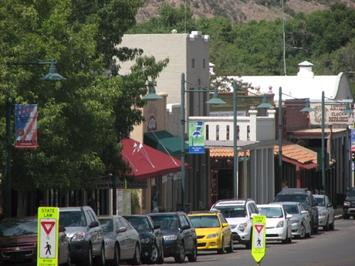
Cottonwood is one of few prohibition-era towns left in the west. Come and learn about Cottonwood’s Bootlegging Days, a town that thrived and survived the depression years! Take a TOUR!
The prohibition-era Cottonwood Hotel is Cottonwood Arizona’s only contributing hotel as historic hotels and places to stay listed on the National Register.
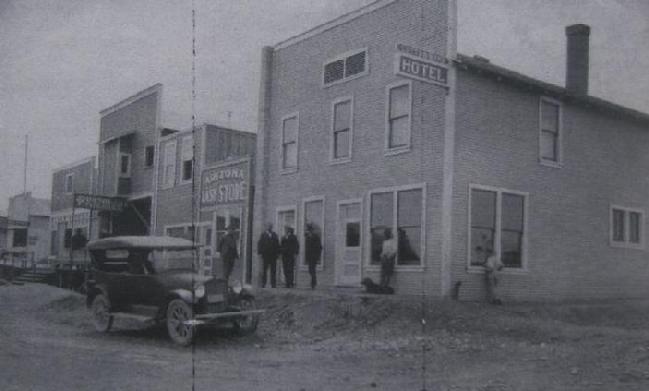
The Cottonwood Hotel is Cottonwood, Arizona’s longest standing business and hotel with the same name and same location since 1917.
The Cottonwood Hotel was first called the OK Hotel
The Cottonwood Hotel (circa 1917) is the smallest hotel in Cottonwood and in the Verde Valley. Today it is a small upper floor prohibition-era boutique hotel with 5 rooms.
Joe Hall (Arizona’s bootlegger King) stayed at the Cottonwood Hotel when he first came to town in July of 1917.
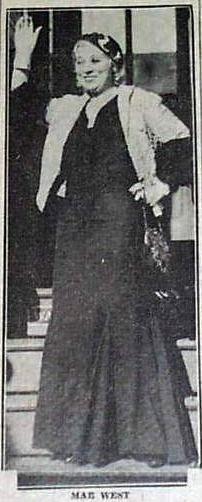
Mae West roomed at the Cottonwood Hotel during the “Roaring Twenties” and again in the 1930’s, and once on her way to her grand opening premier in Phoenix.
The Cottonwood Hotel original wood structure burned to the ground during the 1925 town fire. It had the only town fatality, traveling Reverend George H. Brooks spiritualist, lecturer and known psychic. The town of Cottonwood paid big bucks to bring him into town. Rev. Brooks predicted his death while giving psychic readings only hours before.
NOTE: Reverend Brooks traveled with Senora Blanca also known as La Condesa De Ovies, McDonald, Elenor Cassidy. Mrs. Julien S. de Ovies was the wife of Count Julian de Ovies, Chilean Commercial Commissioner to the United State,(trade relations of the two countries). There was a scandal when his wife Blanca and the Rev. George H. Brooks, pastor of the First Spiritualistic Church both got arrested in the early 1900, Blanca for palm reading and Rev. Brooks for his psychic readings and séances.
930 N. Main… The 1925 commercial front building and 10 room upper floor Cottonwood Hotel was rebuilt after the fire. It had the same floor plan as the original wood structure other then the added large balcony supported by columns that tower over the sidewalks.
The Cottonwood town FIRE BELL was erected on the roof of the Cottonwood Hotel after it was rebuilt. Joe Hall (bootlegger King) was the town fire chief. He would ring the bell when a town fire broke out. The bell remained on top of the Cottonwood Hotel until a fire department was built, after Cottonwood was incorporated in 1960.
1928 Clarkdale Bank Robbers Earl Nelson and Lee Forrester hid out in the Cottonwood Hotel, before making their move on the $50,000 Heist in Clarkdale!
February 6th, 1932. Cottonwood's Sheriff Jesse E. Hood was struck down by a drunk driver on the corner of Main & Pinal and carried 75 feet and dropped at the back door of the Cottonwood Hotel. Jesse Hood was a contractor and built numerous commercial buildings on Main, including the Cottonwood Hotel. He also created the special brick that was used to build the hotel amongst other buildings on Main Street.
John Wayne and Gail Russell romanced at the Cottonwood Hotel during their 1946 filming of 'Angel & the Badman'.
In 1948 the Cottonwood Hotel was advertised in ARIZONA'S HIGHWAY's that the 10 room hotel at that time could be rented for $1.50/night! Today the boutique themed rooms run on an average of $150 for 1 night.
In the early 1950’s, 2 or 3 of the rooms were combined, adding a bathroom to each unit, turning the 10 rooms into 5 rooms, all with their own private bath.
1953 ~ Old man Pop Clanton Advertised for the Cottonwood Hotel Looking as if he had just pulled in from the desert, 'Pop' Clanton one of the few members of his tribe not killed by law officers in Tombstone, guides his caravan up Main Street in Cottonwood. "Partner" says the sign on the wagon, "this is a GOOD TOWN. Pull in and STAY the NIGHT. Pop Clanton Cottonwood, AZ"... That's Clanton behind those enormous boots. He lives on 2nd St. and his dog smokes a pipe. (Verde Independent News Sept. 1953)
The Cottonwood Hotel was part of movie sets in 1946 ‘Desert Fury’ starring Burt Lancaster & ‘Lizabeth Scott, 1967 “Stay Away, Joe, starring Elvis Presley and 1987 ‘Dudes’ starring Jon Cryer
Elvis autographed for fans behind the Cottonwood Hotel as he took to the residential streets… I personally met the director years later, who shared with me that Elvis claimed this filming to be his favorite and having the most fun, even though the movie received poor ratings at the box office.
Elvis was captured by a fan in the liquor store on Main Street buying a coke and a newspaper.
Come & Take An Elvis~ ‘Stay Away Joe’ Tour!
928 N. Main St., contractors Jess Hood and Oscar Webb gave this building an eye appeal with its snappy parapet and swirly stucco. The finished product was described as a “curious building with individuality, a Jazz Palace” (VCN 9/12/1925) The storefront simulating “Toltec Indian architecture with an interior like a copy of the inside of the Carlsbad cavern and the ceiling like the frosting of a cake with snow white miniature stalagtites. All remain as character defining elements of the building today.
One of America’s “MOST WANTED” was found locked up in the old Cottonwood Arizona jail by sheriff Everick "Buck" Snoody. The suspect was then picked up by Los Angeles PD, taken back to California and sentenced to death...The 1967 Dragnet series “The Hammer”(was based on this true story)... DRAGNET: Season 1, Episode 7 – Aired: 3/2/1967
Old Ned, Cottonwood’s town pet, the oldest burro in the state, lived to the age of 44.
Garrison family business, largest privately owned building in the Verde Valley since 1923
Al Capone carved name on the outside jail cell wall of the old 1929 jail
Son of man who brought Al Capone to Cottonwood talks!
Well known architects Royal W. Lescher & Leslie Mahoney designed the 1939 artsy cobble stone Civic Center and other Cottonwood buildings
805 N. Main ~ erected in 1939 by the WPA as the Civic Club
The Civic Club was used as barracks for the defense department World War II flight school trained Naval cadets in the early to middle 1940’s.
Cottonwood is “the gateway to enchantment”
"THE HUB OF THE UNIVERSE" from Arizona Magazine, 1911."THE VERDE VALLEY, THE GARDEN SPOT OF THE NEW STATE"
During prohibition, Cottonwood auto mechanics ingeniously rigged dual tanks on touring cars, one for gas and one for rum running. Engines were supped up to outrun the law.
Cottonwood is blessed with an ideal climate, supplied with an abundance of water for irrigation, and growing the most luscious fruit man has tasted since mother Eve sampled the apples of Eden.
1932 Air Show brought Amelia Earheart, Gladys O’Donnell (1st Women’s Air Derby), Hollywood movie stunt pilots and more to Cottonwood.
Cottonwood to Sedona is 14 miles when hiking the Lime Kiln Trail, historic wagon trail. If you’re driving its 16 miles taking todays historic route 89A.
By 1925 there is not another town in the US that can boost of so many business houses for a population of about 1000. Cottonwood was known as the “Biggest Little Town in Arizona”
Cottonwood Arizona survived the depression years with an industrious bootlegging commerce on Main Street
Recent archeologist, dowser finds entrances to Cottonwood’s bootlegging tunnels.
Ray Manley born and raised in Cottonwood, was an American photographer whose photographs of Arizona, painted a picture-postcard view of the state helped increase tourism and migration to Arizona.
Ray Manley Senior owned Manley Tire Shop and Hopi Court lodge, both in Old Town Cottonwood
Victor Fleming, director of the popular films Wizard of Oz (1939), and Gone with the Wind (1939), for which he won an Academy Award for Best Director died suddenly, while en route to a hospital in Cottonwood, Arizona after suffering a heart attack. He was vacationing in the area with his family.
Betsy Palmer, American actress, best known as a regular panelist on the game show I've Got a Secret, and later for playing Pamela Voorhees in the slasher film Friday the 13th, frequents Old Town Cottonwood shops and cafes.
The Cottonwood Hotel has had a few Hollywood stars, authors and other famous people staying throughout the past 15 years, but the owner is not mentioning any names to protect their privacy.
Old Town Cottonwood has the largest section of the Verde Valley Wine Trail
Old Town Cottonwood has the largest section of the Verde Valley Antique Trail
Old Town Cottonwood is a dog-friendly town with outdoor seating at wine tasting rooms, cafes, restaurants, bars, historic lodging, near hikes with dogs, dog park and doggie day care.
Take A Walk on the Wild Side! Old Town Cottonwood borders a rare greenway riparian. 40 feet from the Jail Trailhead marker is a javelina path. Other unique habitat and vegetation are abound.
Stay in Old Town unique boutique hotels and walk to the Verde River, Dead Horse Ranch State Park, hiking trails, Riverfront Park, disc golf, horseback riding and more.
Camp at the Dead Horse Ranch State Park and hike to Old Town! Where else can you camp in a unique park, along a rare river and greenway and walk to town for breakfast, lunch, wine tasting and more! Only in Cottonwood Arizona!
2001 ~Ermal Williamson, John Wayne impersonator performed at the Cottonwood River Walk Celebration, for National Trail's Day and Grand Opening of the Jail Trail, part of the Verde River Greenway Habitat. Ermal Williamson, recognized internationally as the JOHN WAYNE look-alike, has been impersonating The Duke professionally for years. Ermal is the actor who has made five national Coors Light Beer commercials as John Wayne. He has riden several times in the Festival of Roses Parade, and has patriotically performed at the Pre-Bowl events. He stayed in the John Wayne Suite at the Cottonwood Hotel.
Bob Bradshaw, famous photographer of the Verde Valley, actor & owner of Bradshaw Ranch Movie Location, sat at the Cottonwood Hotel and the old jail, where he autographed and shared his stories of the 144 movies that were filmed on his property between Cottonwood & Sedona on 525 at the Loy Rd. turn off. He was friends with Joseph Becchetti who owned the old Rialto Theater, who brought the “Rushes’ to Cottonwood.
The Bradshaw Ranch has since been confiscated by the government, due to ufos and orb activity. Bob shared those stories too!
Area movie filming brought over 100 ‘Rushes’ to the old Rialto Theater, today’s Tavern Grille location. A “Rush’ was when the directors, producers, and movie stars reviewed and edited their progress of the movie.
Henry Fonda and John Ford, the 1965 movie ‘Rounders’ was the last ‘Rush’ at the Rialto Theater.
Untapped paranormal events in Old Town Cottonwood. ‘Orb Chasing’ is the latest tour and departs from the Cottonwood Hotel! Come and learn about the areas ghosts and other unexplained activity.
Recently recorded paranormal activity in the Old Town Cottonwood Civic Center by Verde Valley Spirit Seekers.
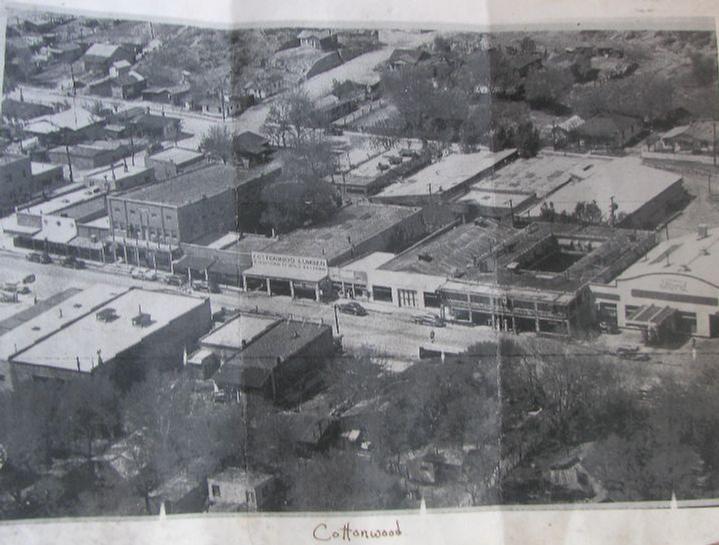
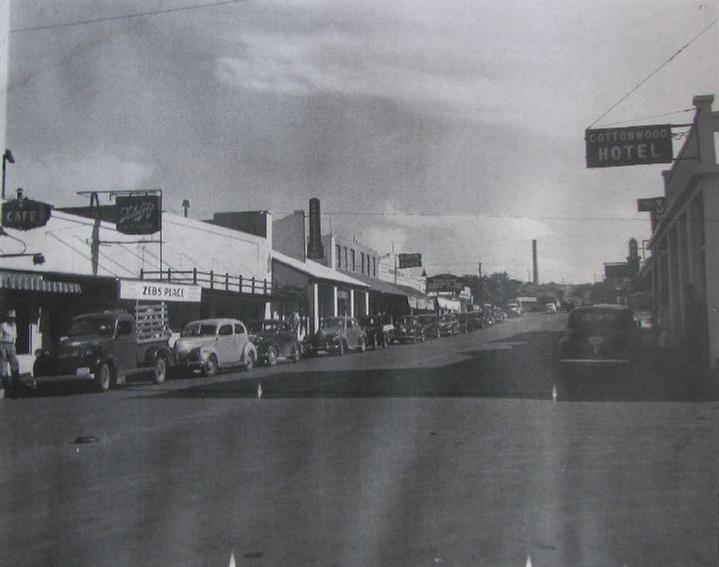
Cottonwood Arizona 1940s
Cottonwood Arizona 1940s
1917: COTTONWOOD BUSINESSES.
research done by Verde Heritage
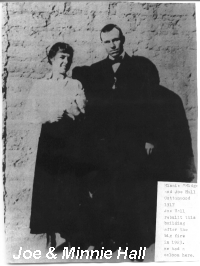
Joseph R. Hall "was shipped over from Hurley, New Mexico, to put the steel up on this Clemenceau smelter." (VVHC, p. 29) Joseph R. and Minna "Minnie" (Meyer) Hall arrived in Cottonwood on July 17, 1917, and checked into the O.K. Hotel. (VVHC, p. 4.) On what is now the corner of Main and Pinal, the hotel had been built by Mr. Beber, and by then it was taxed to capacity every night. (Verde Copper News; August 1, 1917.)
Minnie remembered, "We moved into a little one-room cabin, right across from the hotel there, in the back, on that back street. There was no street, it was just a wide space in the road," (VVHC, p. 29) which is now on the corner of Pinal and Cactus.
By July of 1917, there were 30 to 35 businesses in Cottonwood. Tucker's Chili Stand and Restaurant, operated by F. H. Goodwin, was located back of the O.K. Hotel and across the street from the Hall residence. It was operated without water or electricity in the building, and soon went out of business.
Cottonwood "water was turned into the mains yesterday afternoon for the first time." (Verde Copper News; August 4, 1917.) Employees of the Knasas City Structural Steel Company at the United Verde Extension smelter site had a misunderstanding about the wage scale and stopped working for $6 per day on Thursday, August 9, 1917. (Verde Copper News; August 11, 1917.)
Minnie recalled, "Well, then we lived in Cottonwood and we bought a little cafe, right behind the hotel that was on the corner, a little lunch counter. We bought a little lunch counter just a few weeks after we arrived in Cottonwood, you see, just twelve stools." (VVHC, p. 29.) Minnie said, "We bought it for a song, you know. ... We bought it just as it was; it had everything in it; all we had to do was step in and buy some groceries and go in business." (VVHC, p. 30.)
The newspaper reported, "J. R. Hall has purchased the Tucker chili and lunch stand and reopened the place last Saturday. The only place in Cottonwood to get chili, together with a quick lunch service at reasonable prices will make the chili stand a very popular place to eat." (Verde Copper News; August 27, 1917.) This building was also where J. J. Hemler had a root beer stand.
Minnie continued, "Of course, I didn't know how to cook, but I learned. My husband, he was a kind of half cook, you know, so he bought this lunch counter and we went into business in Cottonwood there. They called it Joe's Chili Joint. ... The fellows from the smelter, that was up there building on the smelter, they were disgusted with the boarding house because the woman wasn't feeding them good, you know, and they'd come down to our place and eat, and we'd throw them out a big hamburger steak ... for seventy-five cents. My husband would go out and buy a quarter of beef, and we had a big icebox, a great big icebox, that held eight hundred pounds of ice." (VVHC, p. 29-30.)
Sam "Steinberg, a business man from Williams is here looking the situation over with the idea of locating a business enterprise in Cottonwood." (Verde Copper News; August 27, 1917.) "A deal was consumated yesterday by which the O.K. Hotel of Cottonwood changes ownership. B. Beber, who built and has conducted the hotel since Cottonwood first 'wooded up' sold the building and contents to S. Steinberg, a business man from Williams, who will take charge in a few days. A number of improvements are contemplated by the new owner, chief among which will be the enlargement of the hotel to take better care of the transient trade, now so noticeably on the increase." (Verde Copper News; August 29, 1917.)
"Steel workers have remained off work until the matter was adjusted by their international union, and when representatives of the workers received notice from their headquarters to go to work they lost no time." They returned to work Wednesday morning, September 5, 1917. (Verde Copper News; September 6, 1917.)
Oasis Confectionery and soft drinks was owned by J. W. Perry in July. "Yesterday, the Oasis ice cream parlor and confectionery was sold by J. W. Perry to Louis Hansen, late of Ajo, for over $500." (Verde Copper News; September 15, 1917.) "Lewis Hansen, proprietor of the Oasis Confectionery, has decided to let the 'wimmin' run it and this morning went up on the works to 'grab him a handful of steel' and get busy. Louie is an old hand for the Kansas City Structural Steel Company and will feel perfectly at home handling things somewhat heavier than ice cream and root beer." (Verde Copper News; September 17, 1917.)
When asked about the customers at Joe's Chili Joint, Minnie said they were "all working men. ... And, then we got some farmers that would come to town and it was advertised that we sold good food and it was cheap. And by gosh, you know, we had a business that wouldn't quit. Just me, and I had a woman cook, a woman helped me, and then my husband, of course, he'd come in and give us a hand." Back of what became the Cottonwood Hotel, Minnie explained, there was a big area, they would park "their cars and wagons there, come in and eat, and then go on their way." (VVHC, p. 31.)
HALL'S GRILL OPENS ON MAIN STREET: "The new eating and rooming station just completed by Joe Hall was opened to the public Thanksgiving day, with a big turkey dinner. When Mr. Hall gets his fixtures all in this will be one of the best equipped places of the kind in the district. He promises to serve his customers with the best eats the markets afford and the most courteous sevices to be had." (Verde Copper News; Saturday, December 1, 1917; page 5.)
"MOVING HOUSE: A force of men are at work moving the house, formerly occupied by the Hemler root beer and Joe's chili stand, on the Stemmer lot on the west side of Main street, Willard addition" (Verde Copper News; Saturday, December 1, 1917; page 5.)
"PICTURE SHOW OPENS: The picture theater that the people of Cottonwood have so long talked and dreamed about opened its doors to the public last night and put on its first production. the house has been ready and the equipment in for several days, but the opening was delayed for want of 'juice.' The connections were made yesterday evening." (Verde Copper News; Saturday, December 1, 1917; page 5.)
See: "Verde Valley Horsemen's Council" (VVHC); MINNA (Hall, Montgomery) PIGMAN: McGuireville, AZ; March 1, 1983; Interview by Cyndy Buchanan; Transcribed by Helga Freud; March, 2003; pages 4, 29, 30, 31.
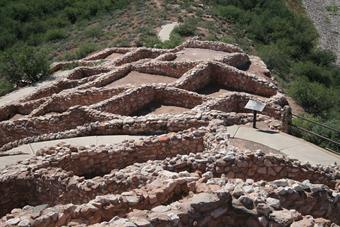
As early as the 700's, the Tuzigoot Sinagua Indians settled in this area due to the wealth of natural resources. Their village consisted of approx. 110 rooms including second and third story pueblo style structures with approximate 250 residents. The tribe disappeared from the area around 1400.
The Tuzigoot National Monument Historic Ruins overlooks the ***Main Street area of historic downtown Old Town, Cottonwood, AZ.
Named after its big cottonwood trees along the Verde River, where settlers once camped and set up tent homes is yet today a hidden gem in the backyard of "Old Town" Cottonwood, AZ.
TODAY
This rare and unique greenway riparian habitat which accesses the Dead Horse Ranch State Park is one of twenty left of its kind in the world. Known as a Fremont Cottonwood/Goodding Willow Riparian, it is one of five remaining stands in Arizona. The one mile trail starts at the western edge of town behind the old jail. It is of a 6 mile reach of the Verde River Greenway, which is only part of the 180 mile long year round flowing river. The riparian is identified with its dense forest of riparian trees and shrubs along its banks and its many rare animals and plants that inhabit this uncommon habitat.
Below are only a few of the nearly 20 threatened and endangered species in this area: ◊ River Otter ◊ Southern Bald Eagle ◊ Southwestern Willow Flycatcher ◊ Lowland Leopard Frog
The area also supports some of the highest breeding bird densities of any North American habitat of rare species. Some of the more common animals in the area are: ◊ Deer ◊ Racoon ◊ Beaver ◊ Coyote ◊ Javelina ◊ Mallard ◊ and the favorite is the great Blue Heron, Verde River Greenway mascot
Three native fish are known to yet exist in the Verde iver and are on the Federal register of endangered species: ◊ Spike Dace Minnow ◊ Colorado Squawfish ◊ Razorblade Sucker
In addition, this area Greenway boosts numerous culturally significant sites from the nearby Tuzigoot National Monument and several yet to be excavated habitations.
and known as Cottonwood was called the "Biggest little town in the state of Arizona".
Click on the pdf. file below to open and print a free Cottonwood Self-Guided Historic Walking Tour
A town famous for bootlegging, feeding the miners and filming movies. Yet a best kept secret and still away from the hustle bustle of the big city atmosphere, the small town is quiet and friendly. A year 'round place to be, in any season, whether for sightseeing or exploring, you'll find Historic Old Town to have its own inspiring beauty...
Cottonwood Hotel early 1922
Cottonwood Hotel 1940's
COTTONWOOD'S Trip to the Past... Experience Cottonwood in the now 21st Century in this turn of the 19th Century, early 20th century Old West charming second story historic hotel. The hotel balcony overlooks the heart of quaint Old Town Cottonwood's downtown area. With upper floor Old Town views, each Apartment Suite has its own unique decor adding to the historic hotel feel and its trip to the past.
Come and stay and walk the streets where legends have...
Some COTTONWOOD, ARIZONA FACTS: The Cottonwood Hotel is Cottonwood, Arizona's oldest hotel. The Cottonwood Hotel is the ONLY lodging with a balcony that overlooks Cottonwood's downtown area. The Cottonwood Hotel was location for the towns FIRE BELL up until the 1960's. The Cottonwood Hotel is COTTONWOOD'S longest standing business with the SAME NAME & SAME LOCATION since 1917...
Sitting in the North Central part of the state, and the heart of the Verde Valley, Cottonwood provides a handy base for those visiting the old mining town of Jerome, the prehistoric ruins at Tuzigoot, wildlife areas, and the other attractions of the Verde Valley. The town is 14 miles northwest of Camp Verde, 16 miles southwest of Sedona, and 41 miles northeast across Mingus Mountain from Prescott.
Some say Cottonwood has a split personality. The original town area now called "Old Town" is separated from the commercial strip development (shopping centers, fast food restaurants and "Big Box" stores) along the new section of AZ 89A, which bypasses Old Town. Old Town has the most personality, as you would expect, and is worth a visit; take the Historic 89A route (same as Main Street) from either Cottonwood or Clarkdale.
Clarkdale, two miles northwest of Cottonwood, still has the look of a company town. From 1912 it housed officials and workers of the smelter that operated nearby. Although a lot of residents lost their jobs when the smelter shut down in 1952, others were glad to be rid of its heavy black smoke. You'll see the giant dome and other structures of the Phoenix Cement Company, which supplied the cement used in building Glen Canyon Dam on the Colorado River.
Late 1500's
In the late 1500’s Spaniards came to the area calling the Verde River, “El Rio de Los Reyes” or the River of Kings as they were lead by Zuni’s to the mines in Jerome. For 25 years more Spaniard expeditions visited Jerome and the Verde Valley, but increasing Indian hostility and the forbidding geography prohibited any other Europeans and Americans from exploring or settling here until the 19th century.
Cottonwood and the Verde River Greenway area was overgrown with native grasses, fruit trees and orchards, cacti, mesquite, juniper and rabbit bush, furnishing excellent hunting for rabbits and quail and deer. It's abundance died of some after the smelter's went in. TODAY the riparian area is protected as it is one of the world's rarest riparian's of its kind. There are only twenty left in the world, five of which are in the state of Arizona and this area is one of them.
Cottonwood was founded in 1879 The settlers at that time were farmers and ranchers. They referred to the area as the 'Verde'... Charles D. Willard settled in the area, bringing with him a mechanic by the name of Neff.
Between 1915-1917 Cottonwood began building their town. Since campfires often burned at the old wagon grounds under the big Cottonwood trees that stood in the wash that extended for several hundred yards to the Verde River from just north of where the old jail building now stands, was known as the 'Cottonwoods'. Cattleman and ranchers from Oak Creek, the lower Verde or Camp Verde and surrounding areas made their over night stops there. Newcomers settling would also pitch a tent or a make shift home down there. As the name Cottonwood got used more and more, they decided it was a beautiful place to build and a great name for their town.
By March of 1917 Cottonwood began booming. Cottonwood appealed to the more venturesome, those who wanted their own home and business. There was a certain reputation for lawlessness. Some who settled in Cottonwood were run out of the nearby company towns. Heavy bootlegging was abound, therefore attracting other non law abiding citizens as well as law abiding from other towns. Cottonwood was known to have the best bootlegging within hundreds of miles, attracting citizens from Los Angeles, Phoenix and closer-to-home folks.
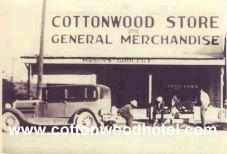
Lon Mason's General Store and Post Office.
Lon Mason's General Store & Post Office 1908-1917 Cottonwood Arizona
May 7, 1917 ~ Jerome Sun Newspaper/ Visitors from everywhere are taking in the sights of the new city. Houses selling~ not many empty lots. Sunday was a great day for Cottonwood. The nice weather and perfect conditions for the young metropolis visitors motoring with their motor vehicles. Visitors came by the hundreds.
May 11, 1917 ~ Jerome Sun Newspaper/Busy times at Cottonwood as people scrambled for real estate. Lots were selling for $125.
COTTONWOOD'S famous bootlegger Joe Hall, was known as the “Bootleg King of Arizona”
On December 3, 1917 his prize whiskey still blew up burning much of the town. Since most of the buildings and homes were of wood, a fire only meant rebuilding the town. The town of Cottonwood was indeed feeling the effects of the good times promised by the erection of the Extension Smelter. New buildings were put up rapidly housing various kinds of businesses.
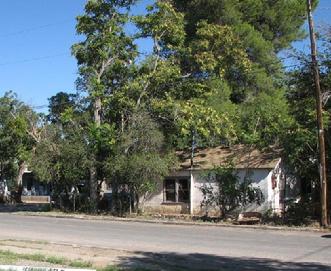
Joe Hall was also the fire marshall and would ring the fire bell located at the Cottonwood Hotel whenever a fire broke out. He saved his family house during the 1925 major fire that burned his business, warehouse and most of the west side of the downtown area. Hall's family house still stands today. It sits on the corner of Pinal & Cactus.
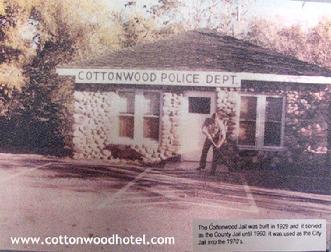
Built in 1917, the Hall house still stands in its original wood construction. The tunnels that went from the rear of the house over to Joe Hall's business (Joe's Bunk & Grille) located at 1004 N. Main Street were closed off after Joe was raided by Ruffner in 1929 and put in jail for 10 months. His prize still sat on top of his wagon which was parked out front of the Old Jail the whole time. When Joe was released, he left Cottonwood and moved to the San Diego, California area. Joe Hall was the FIRST to be jailed in the Old Jail which was built in 1929.
Old Hall House at Pinal & Cactus
Click on the photos below for enlarged views.
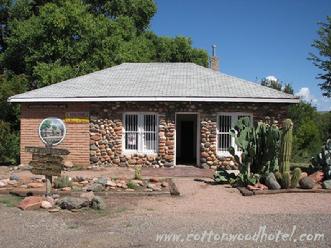
1929 circa historic Old Town Cottonwood Jail
Inside Jail Cell
1929c Old Town Jail (9/11/2008)
1929c Old Town Jail & Trail
Al Capone's name is etched on the outside of the Cottonwood jail cell. It was rumored that he passed through bailing a bootlegger friend out of the old jail. Can you imagine... Al Capone in Cottonwood!
Click on the photo on the right for an enlarged view of Al Capone!
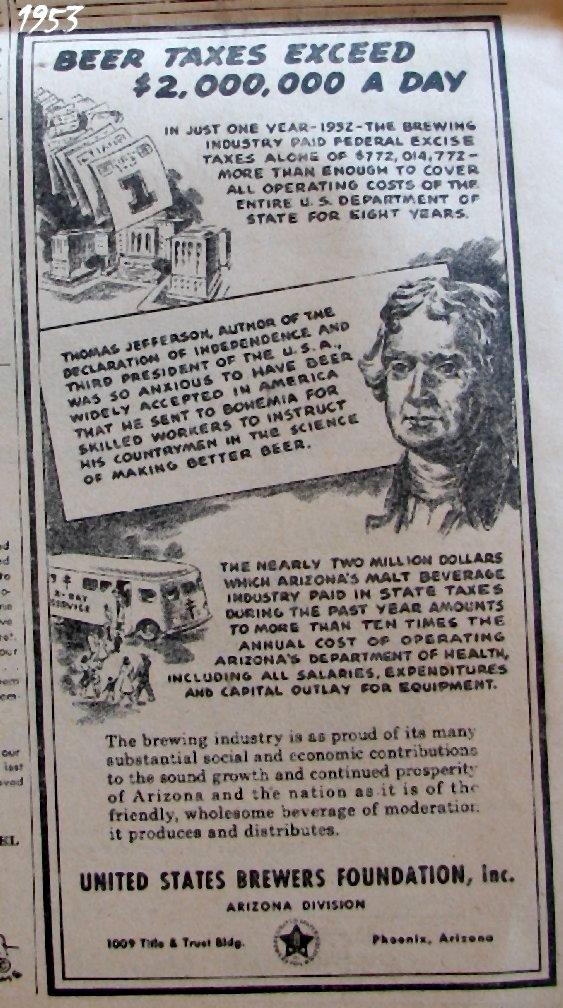
Beer Taxes Exceed $2,000.000 A Day!
1917-1920
According to statistics compiled for the State Directory in the late teens, Cottonwood was represented by 64 businessmen who operated 4 general mercantile stores, 5 stores handling dry goods, 3 restaurants, 1 barbershop, 1 movie picture theater, 1 amusement hall, 1 drugstore, bakery, confectionery, lumber yard, 2 garages, 2 blacksmiths, butcher shop, furniture store, 2 shoe shops, 7 pool halls, service station, ice plant, jewelry shop, 2 hotels, cleaning shop, root beer stand, novelty store and ice cream parlor. The AZ power had a temporary office. Cottonwood proper had 300 residents.
Cottonwood was called the 'Biggest Little Town in Arizona' By the 1920’s ~
There is not another town in the US that can boost of so many business houses for a population of about 1000. Cottonwood was called the 'Biggest Little Town in Arizona'. Merchants were doing a fine business and being busy all the time.
Early 1920’s ~ Mae West Stays in Cottonwood and room's at the Cottonwood Hotel. Mae West hung around Historic Old Town Cottonwood during its prohibition heyday! The days before her career took off, one of the old timers talked about the times Mae was in town. Starry eyed, he was taken with how she got around the speakeasies and played in the mash ready to be stilled in those good ole prized whiskey stills!
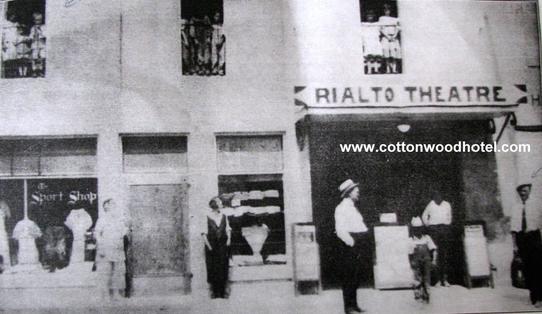
The above picture of the (1st) Rialto Theater was located at 924-926 N. Main St. (TODAY'S location of the Cinnabar Boutique). Joseph Becchetti first built the theater at that location in 1917. In 1923 he built a newer and larger theater at the 914 N. Main St. location (NOW the Tavern Grille). He leased the 924-926 N. Main St. building to Thomas Moore who put a restaurant in at that location in 1923, after Becchetti moved the Rialto to its new location. It was at the 926 N. Main St. location, in the rear of the restaurant that the fire broke out on April 20, 1925.
Fires Burn Down Town! April 20, 1925 at 3 am another prized still blew up. The early morning fire started with the explosion of a prize still located in the rear of the Thomas Moore Restaurant (the Old Rialto Theater) located at 924-926 N. Main St. The fire fanned by a strong wind, swept down the two blocks of the Westside of Main St. all the way down to 1024 N. Main. Fifteen businesses were destroyed along with 10 residential homes behind the business district between Main & Cactus. The one fatality ~ George H. Brooks, a renown minister, Doctor of Divinity & lecturer from Los Angeles who was holding seminars in the area and was staying at the Cottonwood Hotel in which he frequented on a regular basis. It is still a mystery on how he predicted the night before that Cottonwood would see their biggest catastrophe ever and ended up being the only fatality! Some say he is still walking around the hotel in the upper hallway, maybe trying to find his way out!
The 1925 fire was Cottonwood’s biggest catastrophe ever.
Cottonwood 1925 fire.
15 businesses and 10 homes burned to the ground, not including warehouses, cars and machinery. There wasn't enough gloom in the town, yet to find out that they lost a life in the fire.
George H. Brooks, spiritualist lecturer was holding meetings in Cottonwood for several days. It appeared that Brooks had awakened by the fire, partially dressed himself, then fell overcome by the heat and smoke, across from the foot of his bed at the Cottonwood Hotel. His body was horribly burned, little being left but his skeleton. The other roomers made it out of the hotel.
Lysons had a close call as he barely made it out of the rear of his building, as he leaped through a window partially dressed.
The fire burned from the Requenda Saloon & Pool Hall (922 N. Main), a restaurant operated by Thomas Moore (926 N. Main) (where the explosion was and the fire originated) which was the old Rialto Theater (1917-1923). The Lysons building at (928 N. Main) & the Cottonwood Hotel & Mercantile (930 N. Main) were the worst. The flames jumped the street over to the bakery (1002 N. Main). Joe Hall (1004 N. Main) had his whiskey stored between the walls and down in the cellar of his building. Once the fire hit those walls in his Grille another explosion broke out, and quickly caught fire to Hansohn Grocery Store, Asby’s Grocery, Riley’s Variety,Topman’s barbershop, Dr. McClellan’s office, the Pioneer hotel,and Dr. Henderlite’s office . It was contained by then and the Post Office next door had little damage. The Paris Beauty Shop and Tony Butkovich’s new plumbing store on the other side of the street were badly scorched.
Homes behind the business area burned, 3 belonged to Joe Hall, 2 by Mac Willard, 2 by Hansohn, 2 by William Barabee.
The fire was the worst in the recent history of the Verde. Little insurance was on any of the properties, but plans were quickly in the works to rebuild.
It was a day of gloom for Cottonwood. For once stood a hustling commercial area, on this day in 1925 were smoldering heaps, crumbling walls and destroyed furniture. There was much vandalism, by men mostly young boys, rifling off with cash registers and slot machines and other things they took a fancy to. The officers finally put a rope around the block where the Cottonwood Hotel and buildings stood and stationed guards through the next night to prevent the flames from spreading.
Most valiant fire fighting was done by the Eden’s of the Cottonwood Lumber Co. Foster and Braley and a crew of helpers all on the North of the fire zone. Wallace Hancock, W.S. Garrison and another crew fought just as valiantly while on the west of the block where the fire originated were John McIntyre, Joe Becchetti and Peter Henelly with some few helpers. J.R Hall really saved the west side of the street across from the burned area from destruction. Hall lost a big warehouse stored full of machinery and all kinds of mine and pipe equipment. He also lost all of his rental houses on his land, but he did save his own residence. His fire plugs and hoses together with his skill as a nozzleman saved his home, the Eckert residence, garage across the street and Wallace Hancock’s dwelling.
The McIntyre Building and Becchetti's Rialto Theater were not damaged in the fire, which were newer buildings built in 1923 of cast block. They were located on the other side of where the fire originated.
Prescott Evening Courier-April 20, 1925
TWO BURN TO DEATH IN FIRE IN COTTONWOOD
13 Stores, 10 Homes Lost In Conflagration
Blaze Starting in Restaurant Destroys the Entire Block in Valley Town
Loss is said $200,000
Man and Woman Perish in Flames, Fear, Two Others Gone, Under Control
G. H. Brooks, spiritualist minister, of Los Angeles, met his death in the fire that destroyed the Cottonwood Hotel this morning, it has been determined. The man was aroused, when the flames reached the hotel and started to dress but is thought to have been overcome by smoke and fell back on his bed. An unidentified woman is said to have been buried under a falling wall, but her body has not been recovered, it was learned late this afternoon.
Less than half the loss, which will reach about $200,000, was covered by insurance.
Two persons, a man and a woman are dead and two others are missing as the result of a disastrous fire which swept Cottonwood at an early hour this morning, according to word received here. The blaze which is said to have caused approximately $200,000 loss, was of brief duration, starting about 5 o’clock this morning in a small restaurant next door to the Rialto Theater and being under control half an hour later.
Thirteen stores and shops and 10 residences were completely destroyed by the flames which swept a square block in the Verde Valley town, according to R. H. Manley of the Star car agency, one of the fire fighters, who drove to Prescott this morning after flames had been brought under control.
The guests of the Cottonwood Hotel, which was one of the buildings consumed by the flames, had narrow escapes. Two of them, an unidentified woman and a spiritualist preacher, who were guests of the hotel, are alleged to have met their death in the blazing structure. The woman, eye witness said, escaped with the other guests, but ran back into the burning building before she could be stopped. The charred bodies of the two could be seen in the smoking embers of the hotel, Mr. Manley said, after the flames had been extinguished. Two men, residents of this town, are reported to be missing, and it is fearful they have been burned to death.
Little headway could be made in fighting the fire due to the intensity of the flames, which were driven down the main street of the town by the wind and which prevented the fire fighters from getting within 150 feet of the burning structure. By heroic efforts, the post office was saved.
Residents of the little town who were aroused by Mr. Manley, Arthur Lysons of the Lyon’s cigar store and Mr. Eden of the Eden Lumber company, fled to the hills above the city carrying their household goods with them. The fire was checked at the Eden residence by the shifting of the wind.
Deputy Sheriff’s John Munds and Joe Young took charge of the town when the flames died down and spent the rest of the today watching to prevent a recurrence from flying sparks.
The stores and residences which were destroyed are as follows: Raquina pool hall, Rialto theater, Cottonwood Hotel and store, Eckert bakery, Lyson’s cigar store, Eckert Drug store, Joe Hall’s residence, Cottonwood barbershop, Hansohn grocery, Riley Vanity store, Selnas restaurant, Underwood Hotel and several residences.
PRESCOTT EVENING COURIER-APRIL 21, 1925
2 More Bodies In Cottonwood Hotel Ruins
Unidentified Woman, Man Met Death in Confingration of V.V. Town, Aver
YEGGS BLOW UP SAFE
$600 Stolen From Kovacavich Store, Report, After Blaze Sweeps Place
Two persons, an unidentified man and woman who had registered at the Cottonwood Hotel, met their death in the fire which consumed a block of the Verde Valley town at an early hour yesterday, in addition to G. H. Brooks, Los Angeles minister, according to word received from that place today.
The couple, who are known to have registered at the hotel, were caught under a falling wall, it is stated. An effort was made today to cool the embers sufficiently so that the bodies, which were in sight, might be recovered, residents of the town said.
Taking advantage of the general disturbance which followed the conflagration, thieves last night are reported to have blasted open the safe in the Emil Kovacavich store in Cottonwood, which escaped the flames, and to have made their escape with $600.
Read Charlie Stemmer's (Cottonwood' Post Master at the time) paranormal experiences relating to this 1925 fire and Rev Brooks spiritualism by CLICKING HERE.
Even though the April 1925 fire burned most of the town, the whole town rapidly rebuilt with care and caution. Most buildings were completed by summer or September of 1925. It wasn't the first time the town was rebuilt. With businesses thriving in the trades of spirits (best booze within a hundred miles), produce, construction and feeding the miners in Jerome, since 1917, Cottonwood was known as the "Biggest Little Town in the State of Arizona!"
Since the insurance companies would no longer insuring wood buildings or the wooden boardwalks, the hotel was built with a special designed solid cast concrete block and stuccoed over. The blocks had 12-18" of firewall. It was said that they wanted to make dang sure if a building caught fire again it would not burn the whole town. We had proof of the pudding in December of 1998 when the theater burned.
Some homes and buildings were built and rebuilt using the brick they made at the now historic ruins of the Lime Kilns. Horse drawn wagons and carts transported their loads along the Lime Kiln Cut-Off which was a major travel route between the mining town of Jerome and the Oak Creek farming community of Sedona. Spirits from Cottonwood, Oak Creek wine and locally grown produce was bartered for trade between these Verde Valley communities. TODAY it is part of the Dead Horse Ranch State Park located on the Lime Kiln Trail. If you're into hiking go check out the ruins. It's walking distance from the Cottonwood Hotel. The 14 mile Lime Kiln Trail provides an excellent historic trail opportunity for equestrian riders, mountain bicyclists and hikers connecting Dead Horse Ranch State Park TRAIL SYSTEM in Cottonwood to Red Rock State Park in Sedona. The trail is designated as non-motorized, although portions of the trail follow existing road alignments.
Burt Lancastor & 'Liz Scott in Cottonwood movie filming of 1946 Desert Fury
1946 Filming of "Desert Fury" starring Burt Lancastor, 'Lizabeth Scott, John Hodiac
Thursday, Sept. 10, 1953 Pop Clanton The picture below is from the Verde Independent newspaper, Thursday, Sept. 10, 1953. The caption reads, "LOOKING AS IF he had just pulled in from the desert, Pop Clanton, one of the few members of his tribe not killed by law officers in Tombstone, here guides his caravan up Main St. in Cottonwood. "Partner," says the sign on the wagon, "This is a GOOD town. Pull in, Stay the Nite. Pop Clanton, Cottonwood, Ariz." That's Clanton behind those enormous boots. He lives on Second St. and his dog smokes a pipe." (Picture taken in front of the Cottonwood Hotel).
Pop Clanton Walking Advertising for the Cottonwood Hotel says "it's a Good Town, Pull in and Spend the Night!"
Robert S. 'POP' Clanton parked his covered wagon regularly in front of the Cottonwood Hotel. His wagon, sign and his dog smoking a pipe was good advertisement for the hotel. He was friends with Bill Robinson, owner of the Cottonwood Hotel and Robinson's Western Wear Clothier.
R. S. 'Pop' Clanton was born October 11, 1886. Cause of death was cancer. He died on April 18, 1958. He worked the railroad and was a car inspector-repairman.
***I am still trying to find out what house on 2nd Street here in Cottonwood, Arizona that Pop Clanton lived in. If you happen to know, please inform the historian, me via eMail... karen@cottonwoodhotel.com Thank you...
1964 ~ The ROUNDERS
Sedona Finally Called Sedona In Movie Now Being Filmed (Verde Independent Thursday, May 14, 1964). Sedona up until this point was a scene for nearly 100 of Hollywood's most famous western movies, always, however doubling for other places. The 'Rounders' was the first movie in history that Sedona got actual credit under its own name for its film location. 'The Rounders' starring Glenn Ford, Henry Fonda, Chill Wills, Edgar Buchanan and a wild-eyed bucking roan horse named Ol' Fooler, were featured in a parade down on Main Street in Sedona, they also held a rodeo at the posse grounds.
Interesting enough, for COTTONWOOD, the movie was the last movie to use the Rialto Theater for its 'Rushes'...
Elvis Presley ~ 1967 “Stay Away, Joe”
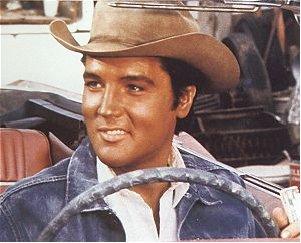
Elvis Cruisin' Main Street in Old Town Cottonwood Arizona
CLICK HERE to read the history about Elvis Presley in Cottonwood Arizona.